Accessibility Review Of ‘Boys From The Blackstuff’ By Alan Bleasdale – Adapted By James Graham

Hi everyone,

Another review in quick succession—seems like I’m on a bit of a roll at the moment! If you haven’t already, feel free to check out my review of *The Da Vinci Code* by following the link here.

Anyway, on with this review! This time, I had the wonderful opportunity to see *Boys From The Blackstuff*, adapted by James Graham and based on the hit TV series. The play tells the story of four men in 1980s Liverpool, doing whatever they can—legally or otherwise—to make ends meet. It’s a sad story at times, but also heart-warming in places. There’s grief and loss, but also some well-timed humour sprinkled throughout.

You really do get a strong sense of just how tough life was for working-class people back then, especially under the pressures of the Thatcher government. The play does a brilliant job of showing the struggle to survive while constantly being forced to stay one step ahead of the system.

I really enjoyed the use of the set and props—both on ground level and above. It was simple yet effective. Wooden boxes were cleverly used as seats and tables, and the occasional piece of real furniture was brought in when needed. One thing I did notice was that a good portion of the show was staged in quite low lighting, often with a blue tint to represent nighttime. I found those scenes a little difficult to see, but thankfully they were mostly dialogue-driven and helped move the story along. The only exception was a slow-motion action sequence at the end.

The entire cast gave fantastic performances. You couldn’t help but feel for the characters and the harsh realities they faced. Watching the show really made me reflect on how much easier many of us have it today. *Boys From The Blackstuff* easily goes down as the best play I’ve seen so far this year, and I’m thrilled to hear it’s heading out on tour.

That said, I was very disappointed to find that there were **no access performances** available—no Audio Description, no Touch Tours, nothing. I understand that this was a short three-day run at The Mercury Theatre, but I do hope that as the show goes on tour, accessible performances will be added. This is an incredibly powerful production that deserves to be experienced by everyone, including those of us with sight loss or other disabilities. Access provisions would only enhance what is already a brilliant show.

Accessibility Review

As mentioned above, this production did not include any accessible performances. So, I can only offer personal recommendations based on my experience.

If you have some useful vision, I’d recommend sitting in Rows D or E for the best view. The set does have some elevated elements, and from further forward you might find yourself craning your neck to catch key moments—though there aren’t too many of those.

If you have little to no vision, the good news is that there are only a few physical or visual fight scenes, and the slow-motion scene at the end. Otherwise, the show is mostly dialogue-driven, which means you won’t miss out on too much of the story. That said, I’d recommend attending with a sighted companion if you can, as they might help fill in some of the visual gaps.

Overall, *Boys From The Blackstuff* tells a gripping and emotional story, brought to life by a phenomenal cast. But the lack of accessible performances was a real let-down. Adding these would make a huge difference and open up the experience to even more people. If anyone from the production team is reading this and would like to discuss accessibility in more detail, please do get in touch.

*Boys From The Blackstuff* is running at The Mercury Theatre in Colchester from Friday 30th May to Saturday 31st May 2025 before heading out on tour. Tickets for the Mercury Theatre run can be found [link here]. For more information about the company and other tour dates, visit their official website [link here].

Accessibility Review: ‘The Da Vinci Code’ Adapted By: Rachel Wagstaff & Duncan Abel

Hello everyone!

Here we are with yet another review! I’ve seen some truly incredible shows so far this year, and I can already tell that writing these reviews is going to be more difficult than usual—each production is setting the bar so high! But as always, I’ll take it one review at a time.

This time, I had the pleasure of seeing The Da Vinci Code, an original production by The Mercury Theatre. Adapted for the stage by Rachel Wagstaff and Duncan Abel, the story follows Harvard symbologist Robert Langdon, who is drawn into a mysterious—and at times dangerous—quest across Paris to uncover the secrets of the Holy Grail.

Based on Dan Brown’s best-selling novel, the plot is packed with twists and turns, moments of joy and sorrow, and is deeply rooted in Catholic tradition and symbolism.

The staging was quite minimal, featuring a raised platform and a flight of stairs, with props and small set pieces brought in between scenes. One of the production’s strongest features was its excellent use of projection. These visuals helped to identify key objects, support the narrative, and even heighten emotional moments by projecting the actors’ faces during dramatic scenes. As someone with limited vision, this was incredibly helpful—it allowed me to see the props and understand visual cues more clearly.

The projections were also used to display keywords, phrases, or excerpts from texts. While the handwriting-style font made some of it difficult to read, the actors thoughtfully read these aloud, ensuring that no one missed important story details.

The cast as a whole did an excellent job bringing this iconic story to life. Joe Bannister gave a standout performance as Robert Langdon, fully embodying the character. Georgia-Mae Myers, as Sophie Neveu, was a perfect counterpart, and their on-stage chemistry added real depth to their relationship.

A special mention must go to Joe Pitts as Silas. His portrayal was both intense and heartfelt. There were several moments when I could truly feel his pain and longing for acceptance. That sense of emotional connection—when a character’s struggle resonates with your own experiences, even in a small way—is the mark of a strong performance.

Accessibility Notes:

As mentioned earlier, the use of projection is a great accessibility feature. It really helped me see smaller or more detailed props and made the story easier to follow visually. I would love to see more productions incorporate this kind of visual support—it makes a real difference for those with low vision.

For blind or severely visually impaired audience members, an audio-described performance and touch tour will be available on Saturday 17th May at 2pm. The show contains only a few action-heavy scenes, most of which involve little movement and are dialogue-driven. If you can’t attend the audio-described performance, you should still be able to follow the plot reasonably well. However, if you’re someone who enjoys catching every detail, I’d definitely recommend taking part in the touch tour and description service.

At the very end of the performance, there is a sudden burst of bright light that fills the stage and surrounding space. As someone who is sensitive to light, I found this a bit overwhelming—but thankfully, it only happens during the finale.

Content Warnings:
The show includes depictions of violence (including gunshots and weapons), simulated sex, cult behavior, full nudity, self-injurious behavior, kidnapping, blood, and themes of death and murder.

The Da Vinci Code runs at The Mercury Theatre in Colchester from Friday 9th May to Saturday 24th May 2025. Tickets are available on the Mercury Theatre website. [Link here.]

Until next time,
The VI Critic

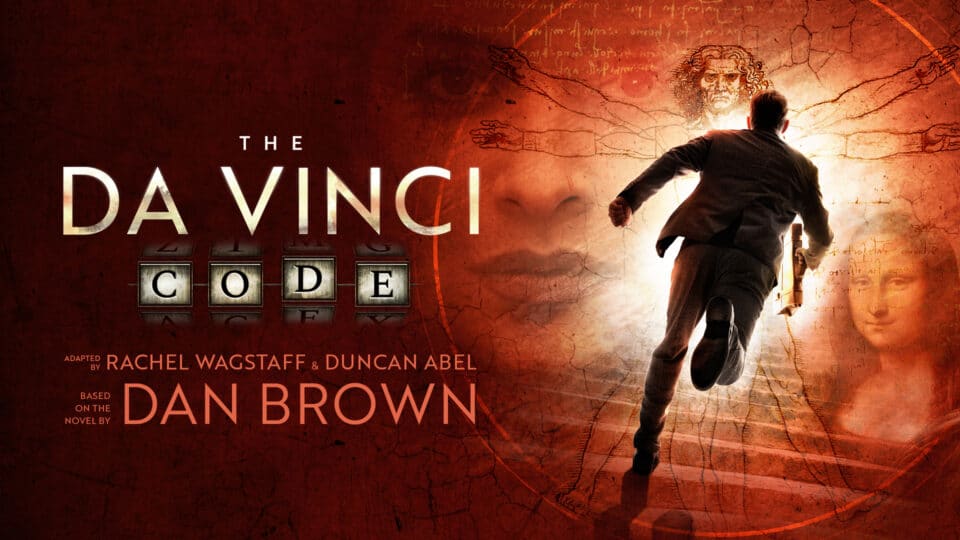
The poster has a dramatic, mysterious tone, dominated by deep red and orange hues. In the center-right, a man in a suit is seen from behind, running up a spiral of stone steps toward a glowing white light. The light forms a portal-like shape, giving the impression of urgency and discovery.

In the background, partially visible through the red texture, are iconic Renaissance images:

Leonardo da Vinci’s “Vitruvian Man”—a sketch of a male figure with outstretched arms and legs inside a circle—is faintly visible in golden tones behind the running man.
The face of the Mona Lisa appears in the bottom-right corner, softly blended into the red-toned background.
A large face of a woman—serene and expressionless—also appears in the center-left background, partially obscured.
At the center-left is the title:
THE DA VINCI CODE, with “CODE” displayed in a metallic block-letter style, resembling a mechanical puzzle or lock.
Beneath the title, it reads:
Adapted by Rachel Wagstaff & Duncan Abel
Based on the novel by Dan Brown—with “Dan Brown” in large, bold red text.

The overall design suggests mystery, symbolism, and urgency, reflecting the thriller’s themes of hidden messages and historical secrets.