Accessibility Review of Mercury Theatre’s ‘Jane Eyre’ Directed By Lily Dyble

Hi everyone and welcome to another review! We’re coming into the colder months now so won’t be too long until my favourite time of year. But until then, I got the chance to see ‘Jane Eyre’ at The Mercury Theatre in Colchester.

Starring Olivia Marus as Jane Eyre. It tells the classic story of a young Victorian orphan through her difficult childhood, into become a passionate young woman in the Victorian era.

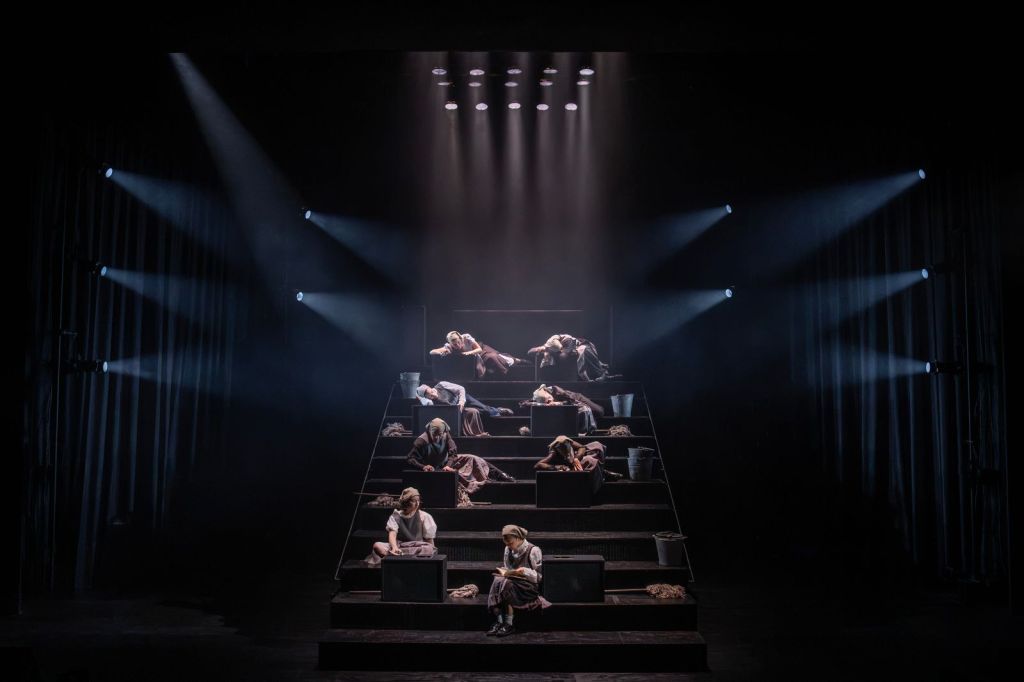
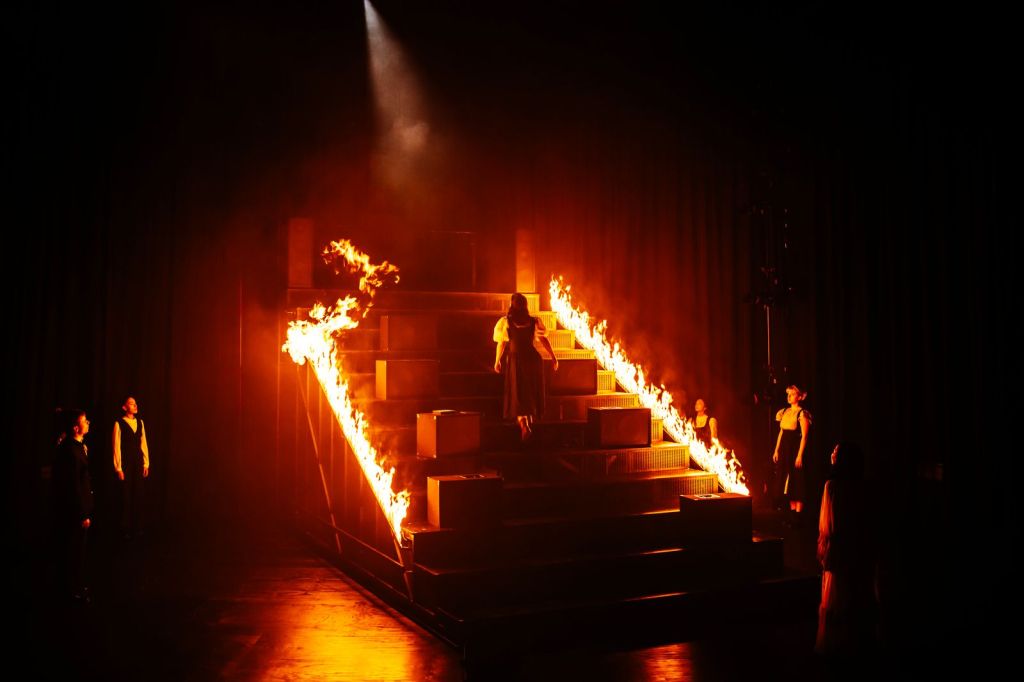
The show is very dark and simple with only a flight of stairs as the set, but with a great use of lighting and sound design each scene feels vastly different from the last. There some uses of bright lights during the show for the more dramatic moments. But they are very far and few between. I think I count three time when this actually happened.

There were some scenes where things did become more difficult to see. This was due very low lighting, or just low lighting then what I would personally need. The use of sounds really adds to the atmosphere of scene brilliant, so it really helped when I struggled to understand the scene from the visual elements.

A stepped wooden platform on a dark stage with several performers arranged across its levels.  
The platform rises like a wide staircase into the background, and each level holds one or two performers dressed in muted brown and gray clothing that suggests historical peasant or servant attire, including long skirts, aprons, and headscarves.  
Most performers are slumped, lying, or sitting in weary poses, some leaning on boxes placed on each step as if they are workstations or beds.  
Metal buckets and piles of what looks like rags or mop heads sit beside some of the boxes, hinting at cleaning or labor.  
Bright, cool-toned stage lights shine diagonally from both sides toward the center and down from above, cutting through haze so that the light beams are clearly visible and framing the performers in a dramatic, somber atmosphere.  
The surrounding stage area beyond the lit platform is mostly in darkness, with only faint outlines of curtains and side lighting rigs visible, so attention is focused on the central group.
Photo Credit: Johan Persson

Olivia Marus and the rest of the cast did an outstanding job, conveying the emotion, and what was at stake in each of the scenes. Andera Gatchalian also really stood at to me as she did an awesome display of emotion and depth for both her characters. To the point where I wanted to look her up in the programme at the interval. As said before Olivia, Andera and all of the cast did a fantastic job in this show. You really did sit there watching this and really wanted things to work out for all the characters.  

This was an excellent modem take on the story in terms of set design, but keeping the known classic story. Directed by Lily Dyble, this show fully displayed her heart, passion, and knowledge within the industry and I fully can’t wait to see what she will be up to next. I will be keeping my eye out for her name in the future, and hopefully that will happen soon! A definite one for the future!  

A large, dramatic staircase on a theater stage with both sides lined in tall orange flames.  
The stairs form a wide pyramid shape, made of dark rectangular blocks that step upward to a flat platform at the top.  
A single bright spotlight from above shines down toward the top center of the structure, cutting through haze or light smoke and emphasizing the heat of the fire.  
On the staircase, a person in a dark dress with short sleeves is walking upward toward the top, facing away.  
The flames are continuous along the outer edges of the stairs, rising several inches to a foot high, with bright yellow and orange tongues and darker smoke near the top.  
The stage floor and background are very dark, almost entirely black, so the fire and the figures are the main visible elements.  
On the lower left side of the image, two people stand on the stage floor, facing the staircase; both wear dark clothing, one in a suit-style outfit with a lighter shirt.  
On the right side of the stage, two more people stand spaced apart, also facing the staircase; they wear sleeveless or short-sleeved dark outfits, their faces and arms lit by the orange glow.  
In the front right corner, nearer to the camera, a figure in a long, light, semi-transparent garment stands watching the scene, mostly in shadow except for some orange highlights from the fire.  
The overall atmosphere is intense and theatrical, with strong contrasts between the bright flames and the surrounding darkness, giving a sense of a climactic or ritual-like moment in a performance.
Photo Credit: Johan Persson

On to the accessibility then:

If you have some useful vision: I think here overall you will be able to follow the story with very little effort. There will be times of both bright and dark moments through the show. But these won’t be for very long. There isn’t a clear difference for each character in terms of costume. Which I think would have really helped here with a lot of blacks or dark blues. The exception to this would be the characters of Mr Rochester and Adele. But will have no problem following the storyline as whole.

If you have little to no useful vision: I think here, there will be some elements of the show you will unfortunately miss out on including some dance and minimal physical scenes accompanied by sound effects. But you will be able to follow the story no problem. Here is an Audio Described performance and Touch Tour on the 10th September 2026, should you wish to have that available to you.

‘Jane Eyre’ is running at The Mercury Theatre in Colchester from 26th September until 10th  October 2026, and then will go on a UK Tour! Information and tickets for The Mercury Theatre will be here. But do check to see if it is coming to theatre near you soon! This is one not to be missed!  

Accessibility Review of ‘Jellyfish’ Written By Jess Coppen-Gardner

Accessibility Review of Mischief’s ‘Thespians’

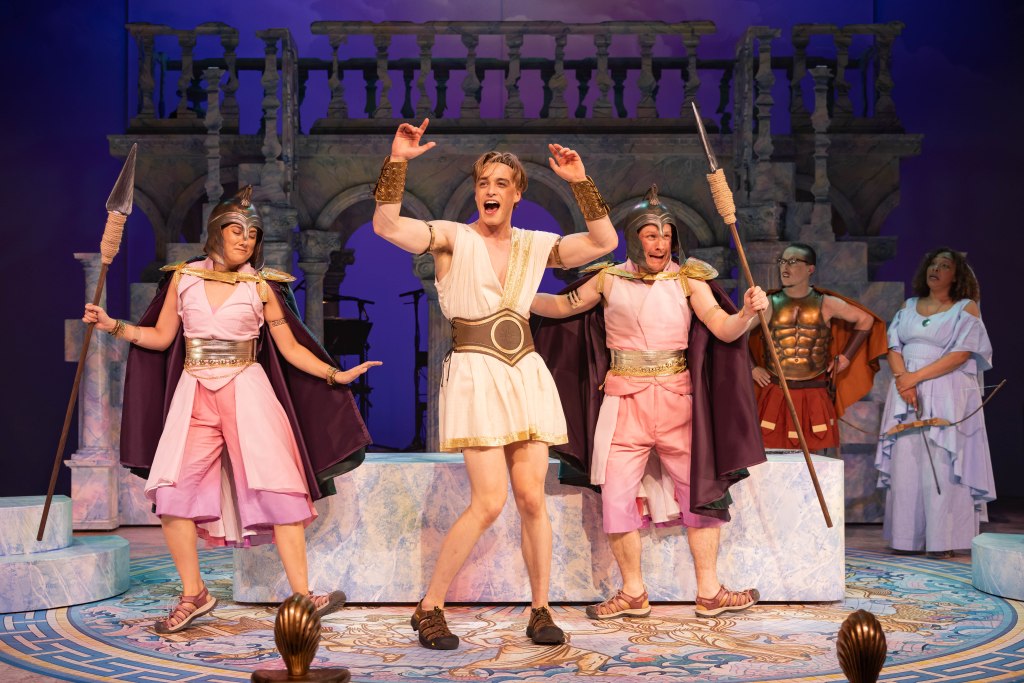
A colorful stage musical scene with actors dressed in ancient Greek-style costumes.  
In the center, a young light-skinned man with short blond hair stands on a round marble-patterned platform. He wears a white sleeveless tunic with a deep V-neck, gold trim, and a wide brown and gold belt. His arms are raised enthusiastically, mouth open in mid-song or shout, and he wears brown sandals and gold wrist bracers.  

On his left and right are two light-skinned performers in matching costumes: pink sleeveless jumpsuits with split skirts, gold belts, metallic gold shoulder pieces, dark purple capes, and bronze-style helmets with crests. Each holds a tall spear upright. The performer on the left poses with one arm extended and knees bent in a dance stance. The one on the right has an animated expression, mouth open, with the spear angled slightly forward.  

Behind them, slightly to the right, stands a person with short dark hair, glasses, and medium skin tone wearing a bronze muscle armor chest plate, red knee-length skirt panels, and an orange cape, watching the central trio. Further right is a woman with medium-brown skin and curly shoulder-length hair, dressed in a light blue, flowing, off-the-shoulder gown with layered ruffles. A bow is in her hand and a quiver of arrows hangs at her side.  

The set is designed like a marble Greek temple, with pale blue and pink marbled columns, arches, and a balcony rail across the back. The floor has an ornate circular design in blues and golds with stylized patterns. The background lighting is purple, giving the scene a fantastical, mythological atmosphere.
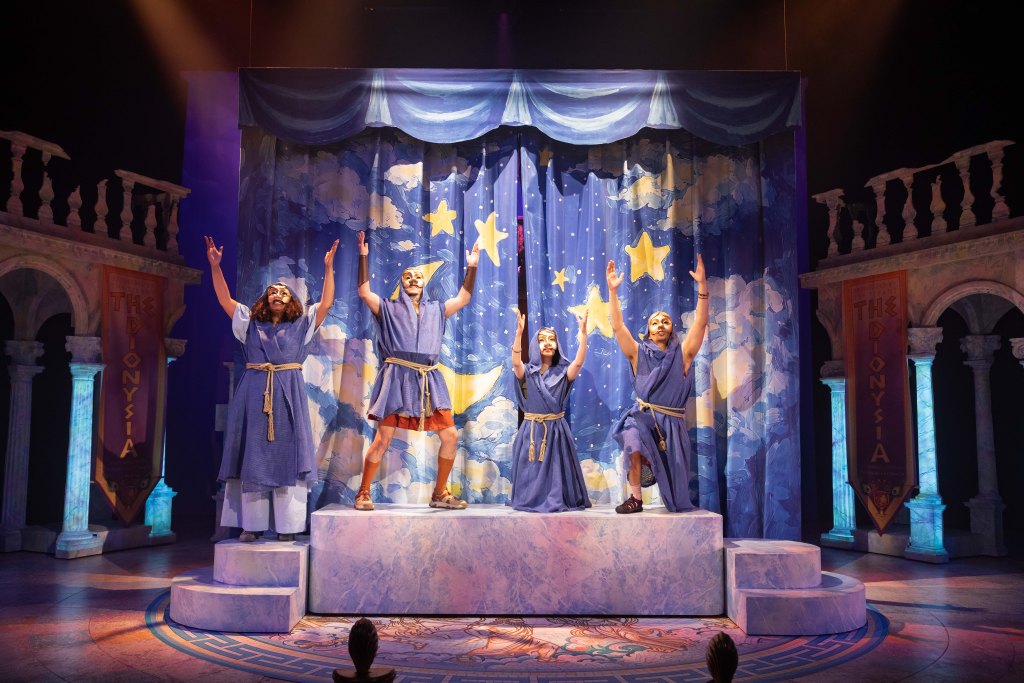
Colorful stage performance with four actors standing on marble-like platforms.  
They are in mid-pose with arms raised, as if celebrating or singing.  
All four wear matching blue tunic-style costumes tied with light-colored rope belts, and theatrical half-masks with exaggerated noses and expressions, reminiscent of ancient Greek comedy masks.  
The center actor’s tunic is shorter, showing bare legs with sandals; the others wear longer, robe-length tunics.  
Behind them is a large curtain painted with a night sky: deep blue background, clouds, yellow stars, and a crescent moon framed by draped blue “fabric” along the top.  
On both sides of the stage are cream-colored stone-like columns and arches suggesting an ancient Greek temple or theater.  
Tall vertical banners hang on each side, reddish-orange with the words “THE DIONYSIA” written vertically.  
Warm stage lighting from above creates a golden glow on the actors and platforms, with some purple and blue light on the backdrop.  
At the very bottom edge, the tops of a few audience members’ heads are just visible, facing the stage.

Accessibility Review Of ‘All The Happy Things’ Written By Naomi Denny

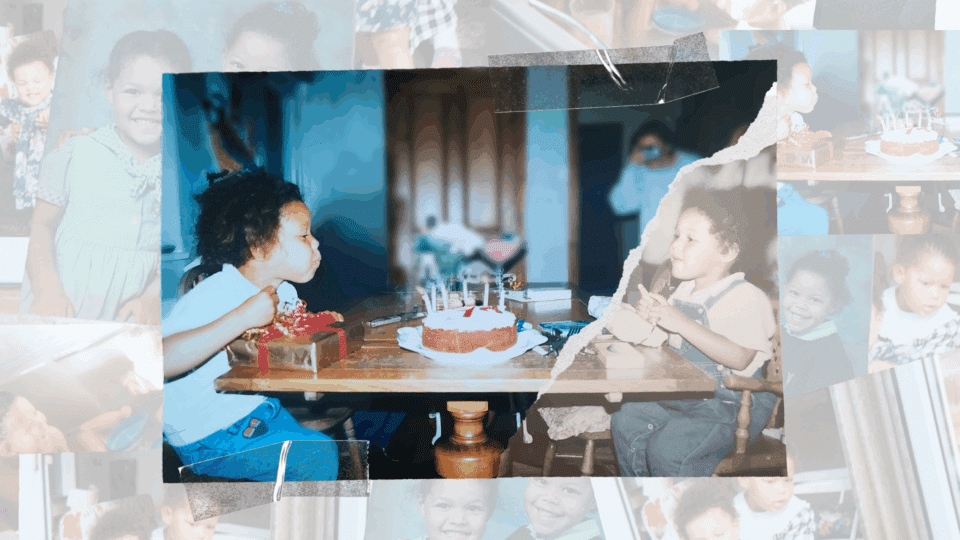
A collage of childhood birthday photos.  

In the main central photo, two small children with medium brown skin and curly dark hair sit facing each other at a wooden table. The child on the left is leaning forward and blowing toward a small round birthday cake with several lit candles. That child wears a light-colored top and blue jeans. The child on the right is smiling, watching, and holding a fork, with a plate of cake in front of them. That child wears a light shirt and blue overalls and sits in a wooden high chair. The table is sturdy with thick turned legs, and the cake is on a white plate with a white cloth or napkin under it. The background shows a doorway and wooden cabinet doors in a home interior.  

This main photo appears slightly torn and taped at the top, with rough white edges on the right side, giving it a scrapbook or nostalgic effect. Faded, semi-transparent photos are layered behind it, showing more images of the same children at different moments: smiling close-ups, another angle of the birthday cake, and casual candid shots. The overall color tone is warm and slightly faded, evoking older printed family photographs.
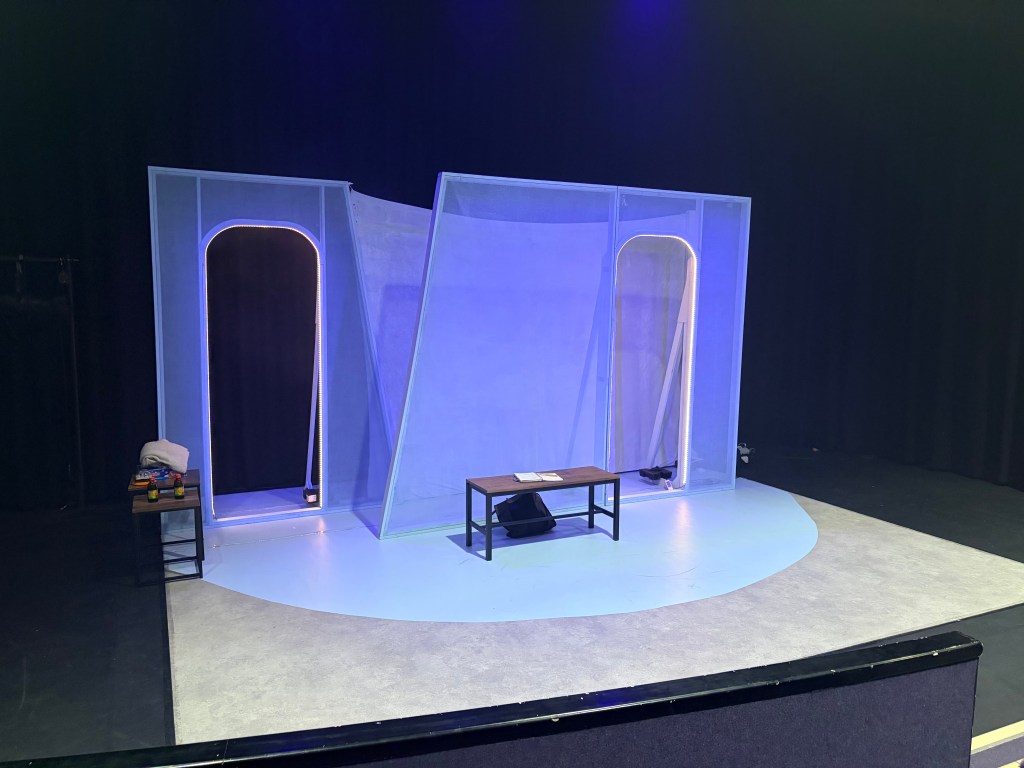
A minimalist theater stage set with cool blue lighting.  
There are three large, slightly angled translucent wall panels across the back of the stage; the left and right panels each have a tall rounded-rectangle doorway outlined with vertical LED strip lights that glow white with a hint of warm color. The center panel is solid and leans slightly, giving the whole wall a stylized, off-kilter look.  

On the floor in front of the wall is a pale blue oval or rounded shape that contrasts with the surrounding light gray stage floor. At the center of this blue area stands a simple rectangular wooden coffee table with dark legs; on top of it are a couple of sheets of white paper. Under the table, near the middle, is a black object that looks like a small bag or case.  

To the far left, just in front of the wall, is a small side table with a dark metal frame and wooden top. On this side table are a folded light-colored towel or cloth and some colorful rectangular items, possibly books or props, along with two small bottles or containers.  

The background beyond the set is all black curtains, and the lighting on the set is primarily blue from above, giving the panels and floor a soft, cool glow while the surrounding stage remains darker.

Accessibility Review of Ava Pickett‘s ‘The Manningtree Witches’

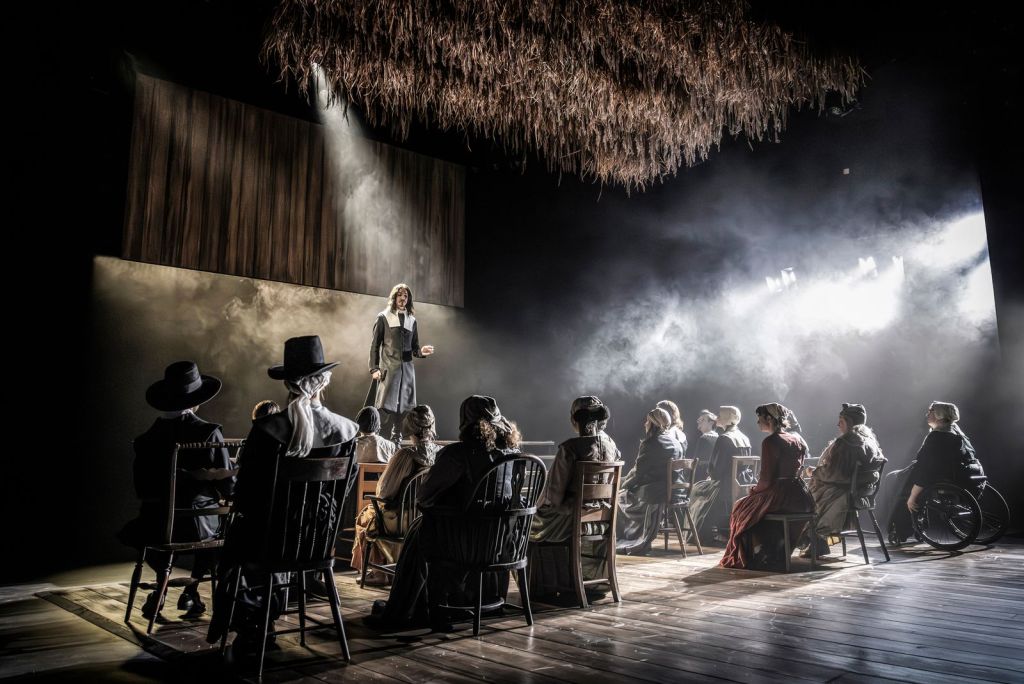
A theater stage scene with a group of people seated in chairs facing a standing speaker under dramatic lighting and fog. The setting looks like a period play: many people wear old-fashioned clothing such as bonnets, shawls, long dresses, and wide-brimmed hats. The speaker stands slightly elevated near the center-left, wearing a long dark coat and light shirt, with long hair, as if addressing the seated group.

A strong spotlight shines down from above onto the speaker, and additional bright stage lights from the right create heavy haze and smoke across the scene. The floor is wooden planks, and the audience on stage sits in several rows of mismatched wooden chairs. A large textured element hangs overhead, resembling a thatched or straw ceiling piece, adding to the rustic atmosphere.
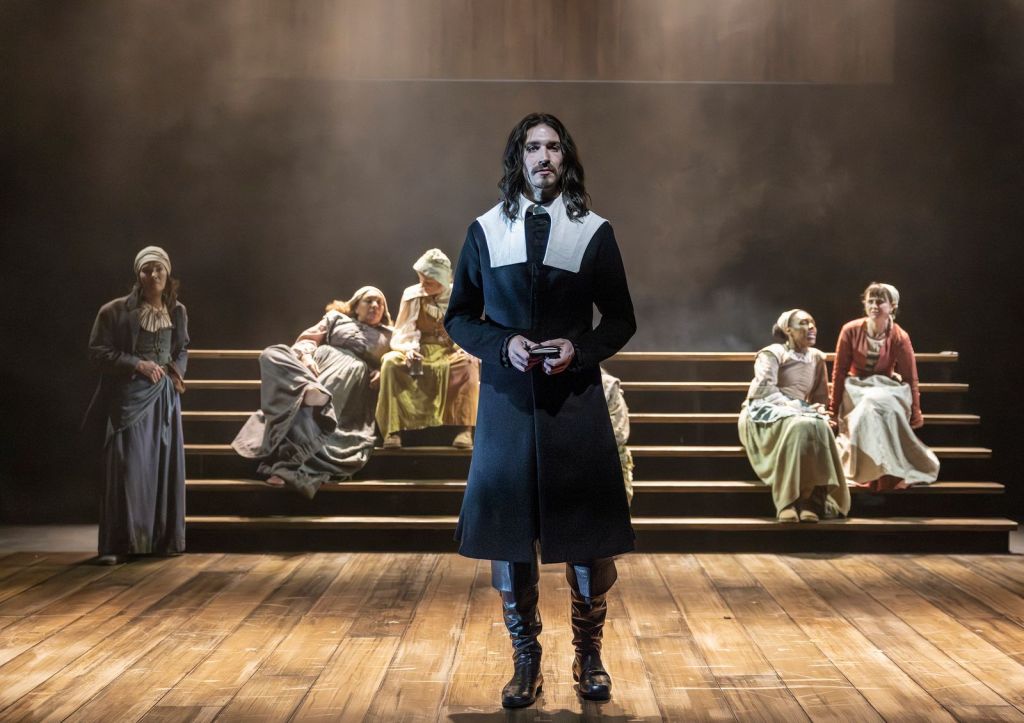
A theater stage scene with a man standing in the center foreground under warm spotlighting, and several women seated on tiered wooden steps behind him. The man has light skin and long dark wavy hair, and wears a long dark coat with a wide white collar and tall dark boots. He is facing forward with a serious expression and holding a small object in both hands at waist level. Behind him, women in muted, old-fashioned dresses and head coverings sit or lean on the steps, spaced across the background. The stage floor is wooden, and the back of the stage is dark with haze or smoke catching the light.

Trailer (With Audio Description):

Accessibility Review: ‘Mother Goose!’ The Beating Heart Of Christmas Comes Back To The Mercury Theatre!

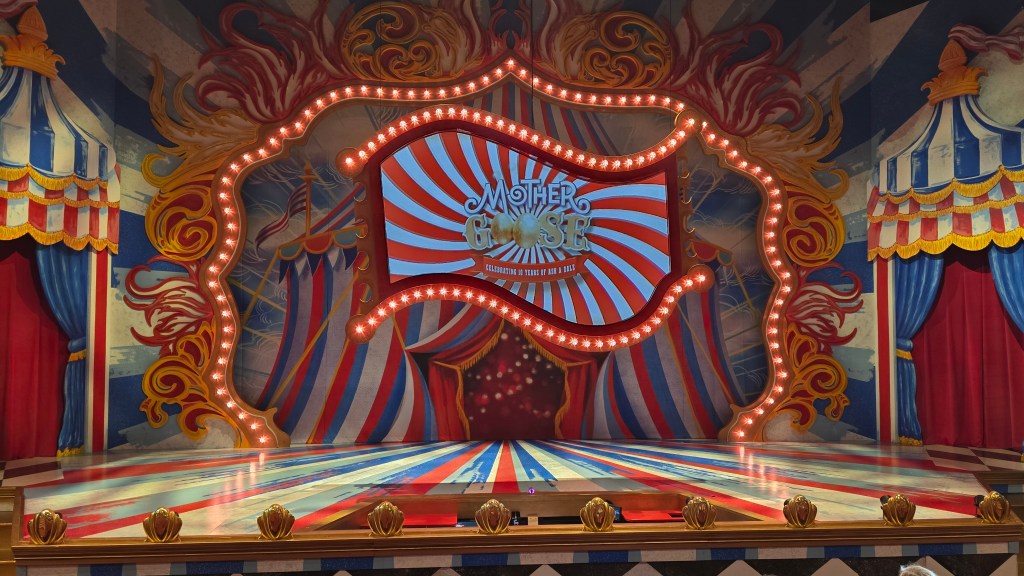
Image shows a inside of a  Circus tent pantomime set with a giant screen the middle showing the title mother goose! The colours are the tradition circus colours of red white and  blue
Image shows lots of colourful show lights and smoke with dancers in clown costume dancing behind Gertie Goose (Anthony Stuart-Hicks
Image shows a close of Gertie Goose (Anthony Stuart-Hicks in full make up and wear a circus tent inspired dress! With a small tent top on her head!
Billy the goose (Dale Superville) wear a white bowler hat with a feather in it. He is always wearing a white feather like jacket with wings and white gloves. While also wear orange tights and orange sneakers.

Accessibility Review of Tassa Deparis’s ‘Swallow The Lake’

Hi everyone, and welcome back to another review!

I was kindly invited to the Mercury Theatre to see their new Original production, Swallow The Lake — a heartfelt and thought-provoking piece that stayed with me long after the curtain fell.

The story follows Joanna, a young woman who’s spent much of her life abroad due to her father’s career as an army chef. Constantly on the move, she’s never truly had a place to call home. We watch her journey unfold from a curious child to a grown woman searching for belonging — but the question lingers: has she really found happiness?

Written by Tassa Deparis, Swallow The Lake is a touching exploration of childhood innocence, growing pains, and self-discovery. It delves into family tensions, teenage friendships, and the heartbreaks that shape who we become — themes that almost anyone can relate to.

A woman sits barefoot on the edge of a wooden table, surrounded by tall golden reeds that fill the background. She has long curly dark hair and a warm, joyful expression, looking slightly upwards with a soft smile. She’s wearing a loose, cream-coloured blouse with full sleeves and light beige trousers. The lighting is gentle and warm, giving the scene an autumnal, golden glow. The overall feeling is calm, intimate, and slightly nostalgic — as if she’s lost in a happy memory or daydream.

The production takes place in the Mercury Studio, an intimate venue that brings the audience remarkably close to the action. It’s a setting that allows for a real emotional connection between performers and audience members — though, as I discovered, it’s not the most generous when it comes to legroom! Still, the closeness makes the experience all the more immersive and, for many, more accessible.

Lydia Bakeelmun gives a standout performance, showcasing remarkable range and emotional depth. Her portrayal of Joanna is both tender and powerful — by the end, I genuinely felt for her. Matthew Jewson delivers an equally strong performance opposite her, and together they bring a wonderful authenticity to their characters. Watching them transform seamlessly from childhood to adulthood was truly captivating.

Supporting them, Liam Bull and Krupa Pattani shine in multiple roles throughout the show. Both demonstrate an impressive versatility, shifting between characters with ease. It’s a skill that’s much harder than it looks, yet they make it appear effortless.

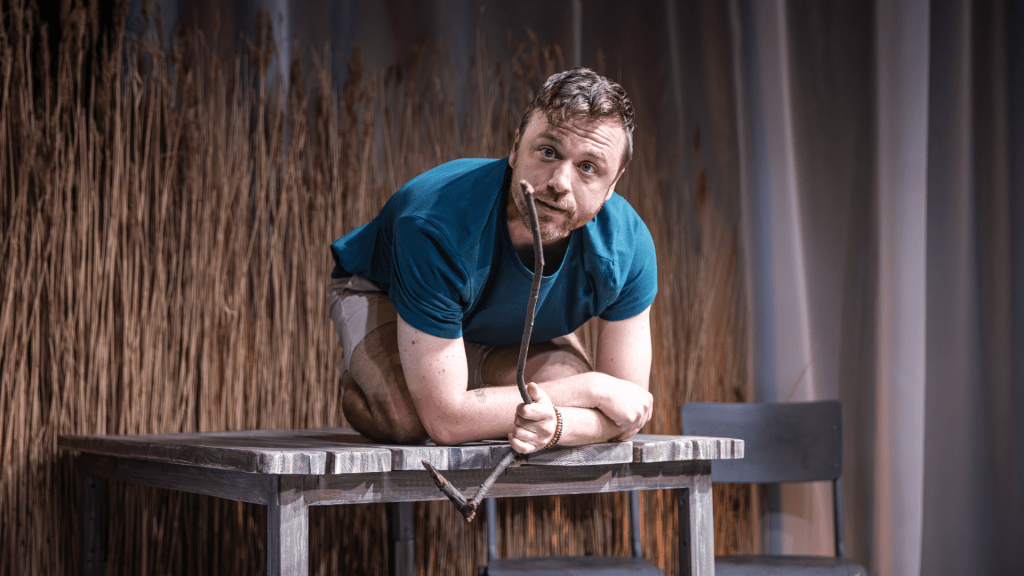
A man crouches on top of the same wooden table, holding a long stick in his hands and leaning slightly forward as if pretending to draw in the sand or poke at something on the ground. He has short hair and a thoughtful, focused expression, with a hint of curiosity or playfulness. He’s wearing a short-sleeved blue T-shirt and beige shorts. Behind him, the same tall golden reeds create a natural, rustic backdrop, softly lit in warm tones. The lighting feels gentle and earthy, suggesting an outdoor or beach-like setting.

The staging is simple but beautifully effective. Tall beach grass borders parts of the stage, while soft, semi-transparent curtains — gently lit from behind — help define each new scene. A few benches, chairs, and a table are all that’s needed to bring the world to life, letting the performances take centre stage.

Most of the show is dialogue-driven, with minimal physical action or bright lighting. The atmosphere remains soft and natural throughout — calm, reflective, and intimate. However, I was disappointed to find there was no touch tour or audio description available. While some may argue that this production doesn’t strictly require audio description, I believe access options should always be available for those who need them. Even a short touch tour to explore the set and costumes would have been a welcome addition.

For those with useful vision, you can choose how close you sit without worrying about harsh lighting or sudden flashes. If you have little or no vision, the show is still easy to follow thanks to its strong script and clear dialogue. A few small visual moments — like someone pretending to chase chickens or draw in the sand — might be missed, but they don’t detract from the overall experience.

Overall, Swallow The Lake is a must-see for its outstanding performances and emotionally resonant storytelling.It’s an intimate, beautifully acted piece that captures the highs and lows of growing up and finding your place in the world.

Until next time,
The VI Critic

A striking underwater image featuring a young woman submerged in clear blue water. Her eyes are closed, and she appears calm and peaceful, with small air bubbles surrounding her face. Her curly dark hair floats gently around her head, fanning out in soft waves. She holds her hands delicately near her face, fingertips touching her cheeks and chin, as if caught in a moment of stillness or reflection. The water gives her skin a smooth, glowing look, and the light filters down in a serene, dreamlike way.
To the left of the image, in large pale cream-coloured text, are the words:
“SWALLOW THE LAKE”
and beneath in smaller text:
“BY TASSA DEPARIS.”

Accessibility Review: Flumps – A Powerful and Playful Exploration of Childhood Resilience

Picture shows Harvey (Robyn Holdawy) and Felicity (Jadie Rose Hobson) with Harvey looking crazy into the distance with Felicity looking puzzled holding a dog.
Picture shows Harvey (Robyn Holdawy) and Felicity (Jadie Rose Hobson) in a run down caravan with Felicity playing with a dog on the floor with Harvey looking on.

Accessibility Review Of ‘Boys From The Blackstuff’ By Alan Bleasdale – Adapted By James Graham

Hi everyone,

Another review in quick succession—seems like I’m on a bit of a roll at the moment! If you haven’t already, feel free to check out my review of *The Da Vinci Code* by following the link here.

Anyway, on with this review! This time, I had the wonderful opportunity to see *Boys From The Blackstuff*, adapted by James Graham and based on the hit TV series. The play tells the story of four men in 1980s Liverpool, doing whatever they can—legally or otherwise—to make ends meet. It’s a sad story at times, but also heart-warming in places. There’s grief and loss, but also some well-timed humour sprinkled throughout.

You really do get a strong sense of just how tough life was for working-class people back then, especially under the pressures of the Thatcher government. The play does a brilliant job of showing the struggle to survive while constantly being forced to stay one step ahead of the system.

I really enjoyed the use of the set and props—both on ground level and above. It was simple yet effective. Wooden boxes were cleverly used as seats and tables, and the occasional piece of real furniture was brought in when needed. One thing I did notice was that a good portion of the show was staged in quite low lighting, often with a blue tint to represent nighttime. I found those scenes a little difficult to see, but thankfully they were mostly dialogue-driven and helped move the story along. The only exception was a slow-motion action sequence at the end.

The entire cast gave fantastic performances. You couldn’t help but feel for the characters and the harsh realities they faced. Watching the show really made me reflect on how much easier many of us have it today. *Boys From The Blackstuff* easily goes down as the best play I’ve seen so far this year, and I’m thrilled to hear it’s heading out on tour.

That said, I was very disappointed to find that there were **no access performances** available—no Audio Description, no Touch Tours, nothing. I understand that this was a short three-day run at The Mercury Theatre, but I do hope that as the show goes on tour, accessible performances will be added. This is an incredibly powerful production that deserves to be experienced by everyone, including those of us with sight loss or other disabilities. Access provisions would only enhance what is already a brilliant show.

Accessibility Review

As mentioned above, this production did not include any accessible performances. So, I can only offer personal recommendations based on my experience.

If you have some useful vision, I’d recommend sitting in Rows D or E for the best view. The set does have some elevated elements, and from further forward you might find yourself craning your neck to catch key moments—though there aren’t too many of those.

If you have little to no vision, the good news is that there are only a few physical or visual fight scenes, and the slow-motion scene at the end. Otherwise, the show is mostly dialogue-driven, which means you won’t miss out on too much of the story. That said, I’d recommend attending with a sighted companion if you can, as they might help fill in some of the visual gaps.

Overall, *Boys From The Blackstuff* tells a gripping and emotional story, brought to life by a phenomenal cast. But the lack of accessible performances was a real let-down. Adding these would make a huge difference and open up the experience to even more people. If anyone from the production team is reading this and would like to discuss accessibility in more detail, please do get in touch.

*Boys From The Blackstuff* is running at The Mercury Theatre in Colchester from Friday 30th May to Saturday 31st May 2025 before heading out on tour. Tickets for the Mercury Theatre run can be found [link here]. For more information about the company and other tour dates, visit their official website [link here].

Accessibility Review: ‘The Da Vinci Code’ Adapted By: Rachel Wagstaff & Duncan Abel

Hello everyone!

Here we are with yet another review! I’ve seen some truly incredible shows so far this year, and I can already tell that writing these reviews is going to be more difficult than usual—each production is setting the bar so high! But as always, I’ll take it one review at a time.

This time, I had the pleasure of seeing The Da Vinci Code, an original production by The Mercury Theatre. Adapted for the stage by Rachel Wagstaff and Duncan Abel, the story follows Harvard symbologist Robert Langdon, who is drawn into a mysterious—and at times dangerous—quest across Paris to uncover the secrets of the Holy Grail.

Based on Dan Brown’s best-selling novel, the plot is packed with twists and turns, moments of joy and sorrow, and is deeply rooted in Catholic tradition and symbolism.

The staging was quite minimal, featuring a raised platform and a flight of stairs, with props and small set pieces brought in between scenes. One of the production’s strongest features was its excellent use of projection. These visuals helped to identify key objects, support the narrative, and even heighten emotional moments by projecting the actors’ faces during dramatic scenes. As someone with limited vision, this was incredibly helpful—it allowed me to see the props and understand visual cues more clearly.

The projections were also used to display keywords, phrases, or excerpts from texts. While the handwriting-style font made some of it difficult to read, the actors thoughtfully read these aloud, ensuring that no one missed important story details.

The cast as a whole did an excellent job bringing this iconic story to life. Joe Bannister gave a standout performance as Robert Langdon, fully embodying the character. Georgia-Mae Myers, as Sophie Neveu, was a perfect counterpart, and their on-stage chemistry added real depth to their relationship.

A special mention must go to Joe Pitts as Silas. His portrayal was both intense and heartfelt. There were several moments when I could truly feel his pain and longing for acceptance. That sense of emotional connection—when a character’s struggle resonates with your own experiences, even in a small way—is the mark of a strong performance.

Accessibility Notes:

As mentioned earlier, the use of projection is a great accessibility feature. It really helped me see smaller or more detailed props and made the story easier to follow visually. I would love to see more productions incorporate this kind of visual support—it makes a real difference for those with low vision.

For blind or severely visually impaired audience members, an audio-described performance and touch tour will be available on Saturday 17th May at 2pm. The show contains only a few action-heavy scenes, most of which involve little movement and are dialogue-driven. If you can’t attend the audio-described performance, you should still be able to follow the plot reasonably well. However, if you’re someone who enjoys catching every detail, I’d definitely recommend taking part in the touch tour and description service.

At the very end of the performance, there is a sudden burst of bright light that fills the stage and surrounding space. As someone who is sensitive to light, I found this a bit overwhelming—but thankfully, it only happens during the finale.

Content Warnings:
The show includes depictions of violence (including gunshots and weapons), simulated sex, cult behavior, full nudity, self-injurious behavior, kidnapping, blood, and themes of death and murder.

The Da Vinci Code runs at The Mercury Theatre in Colchester from Friday 9th May to Saturday 24th May 2025. Tickets are available on the Mercury Theatre website. [Link here.]

Until next time,
The VI Critic

The poster has a dramatic, mysterious tone, dominated by deep red and orange hues. In the center-right, a man in a suit is seen from behind, running up a spiral of stone steps toward a glowing white light. The light forms a portal-like shape, giving the impression of urgency and discovery.

In the background, partially visible through the red texture, are iconic Renaissance images:

Leonardo da Vinci’s “Vitruvian Man”—a sketch of a male figure with outstretched arms and legs inside a circle—is faintly visible in golden tones behind the running man.
The face of the Mona Lisa appears in the bottom-right corner, softly blended into the red-toned background.
A large face of a woman—serene and expressionless—also appears in the center-left background, partially obscured.
At the center-left is the title:
THE DA VINCI CODE, with “CODE” displayed in a metallic block-letter style, resembling a mechanical puzzle or lock.
Beneath the title, it reads:
Adapted by Rachel Wagstaff & Duncan Abel
Based on the novel by Dan Brown—with “Dan Brown” in large, bold red text.

The overall design suggests mystery, symbolism, and urgency, reflecting the thriller’s themes of hidden messages and historical secrets.