Hello everyone!
Here we are with yet another review! I’ve seen some truly incredible shows so far this year, and I can already tell that writing these reviews is going to be more difficult than usual—each production is setting the bar so high! But as always, I’ll take it one review at a time.
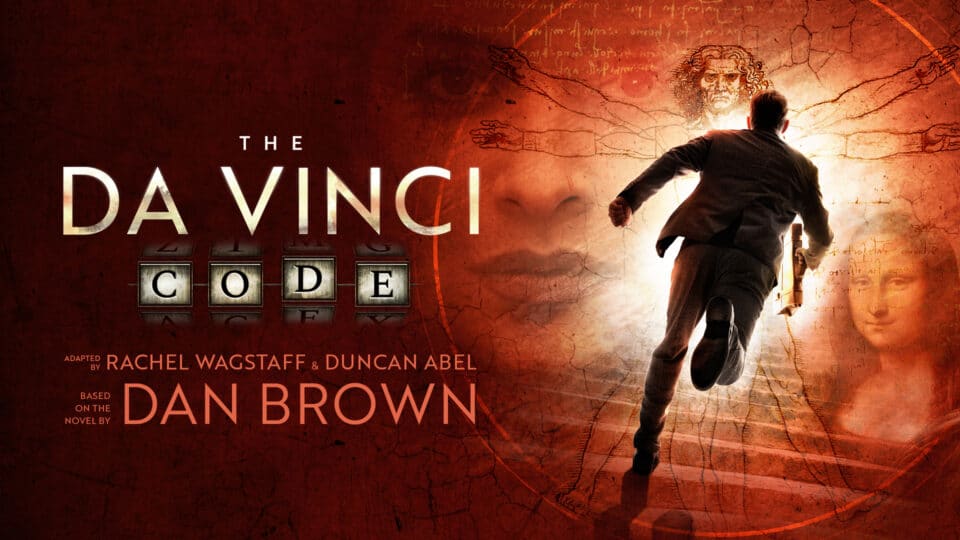
This time, I had the pleasure of seeing The Da Vinci Code, an original production by The Mercury Theatre. Adapted for the stage by Rachel Wagstaff and Duncan Abel, the story follows Harvard symbologist Robert Langdon, who is drawn into a mysterious—and at times dangerous—quest across Paris to uncover the secrets of the Holy Grail.
Based on Dan Brown’s best-selling novel, the plot is packed with twists and turns, moments of joy and sorrow, and is deeply rooted in Catholic tradition and symbolism.
The staging was quite minimal, featuring a raised platform and a flight of stairs, with props and small set pieces brought in between scenes. One of the production’s strongest features was its excellent use of projection. These visuals helped to identify key objects, support the narrative, and even heighten emotional moments by projecting the actors’ faces during dramatic scenes. As someone with limited vision, this was incredibly helpful—it allowed me to see the props and understand visual cues more clearly.
The projections were also used to display keywords, phrases, or excerpts from texts. While the handwriting-style font made some of it difficult to read, the actors thoughtfully read these aloud, ensuring that no one missed important story details.
The cast as a whole did an excellent job bringing this iconic story to life. Joe Bannister gave a standout performance as Robert Langdon, fully embodying the character. Georgia-Mae Myers, as Sophie Neveu, was a perfect counterpart, and their on-stage chemistry added real depth to their relationship.
A special mention must go to Joe Pitts as Silas. His portrayal was both intense and heartfelt. There were several moments when I could truly feel his pain and longing for acceptance. That sense of emotional connection—when a character’s struggle resonates with your own experiences, even in a small way—is the mark of a strong performance.
Accessibility Notes:
There are several dark scenes throughout the show, with near-total darkness during scene changes. One scene in particular features a character lit only by a single white spotlight, which makes it slightly harder to follow visually. That said, the action at that moment is minimal, focusing mainly on dialogue.
As mentioned earlier, the use of projection is a great accessibility feature. It really helped me see smaller or more detailed props and made the story easier to follow visually. I would love to see more productions incorporate this kind of visual support—it makes a real difference for those with low vision.
For blind or severely visually impaired audience members, an audio-described performance and touch tour will be available on Saturday 17th May at 2pm. The show contains only a few action-heavy scenes, most of which involve little movement and are dialogue-driven. If you can’t attend the audio-described performance, you should still be able to follow the plot reasonably well. However, if you’re someone who enjoys catching every detail, I’d definitely recommend taking part in the touch tour and description service.
At the very end of the performance, there is a sudden burst of bright light that fills the stage and surrounding space. As someone who is sensitive to light, I found this a bit overwhelming—but thankfully, it only happens during the finale.
Content Warnings:
The show includes depictions of violence (including gunshots and weapons), simulated sex, cult behavior, full nudity, self-injurious behavior, kidnapping, blood, and themes of death and murder.
The Da Vinci Code runs at The Mercury Theatre in Colchester from Friday 9th May to Saturday 24th May 2025. Tickets are available on the Mercury Theatre website. [Link here.]
Until next time,
The VI Critic
 The VI Critic
Pingback: Accessibility Review Of ‘Boys From The Blackstuff’ By Alan Bleasdale – Adapted By James Graham | The VI Critic